
Louise Lear is a familiar face to many people who have watched BBC weather forecasts over the years. Her calm delivery, clear explanations and occasional moments of spontaneity have helped make her one of the better-known weather presenters on British television.
What makes Louise Lear’s career interesting, though, is that she did not start out with a straightforward plan to become a famous weather presenter. Her background includes music and drama, television research, sports broadcasting and radio before weather forecasting became the main focus of her professional life.
That gradual career path is worth looking at because it shows something that is easy to miss when watching a polished television presenter: the person on screen is usually the result of years of different experiences rather than one lucky break.
Who is Louise Lear?
Louise Lear, whose birth name is reported as Tracy Louise Barden, was born on 14 December 1967 in Sheffield, England. She grew up in Leicestershire and later studied at Middlesex University, where she graduated with a BA in Music and Drama in 1988. She has also been associated with playing the piano and clarinet.
She is best known for her work as a BBC weather presenter. Her broadcasting career has included appearances on BBC News, BBC World News, BBC Radio and BBC Red Button, as well as programmes such as BBC Breakfast and Countryfile.
For viewers who only know her from the weather map, that wider background can be surprising. Weather presentation may look like a very specialised job, but it actually requires a mixture of journalism, live television technique, timing and the ability to explain technical information quickly.
Louise Lear’s early life and education
Lear was born in Sheffield but spent much of her childhood in the village of Rothley in Leicestershire. She attended Humphrey Perkins School before moving to Rawlins Academy in Quorn, where she completed her O-levels and A-levels.
Her university education is particularly interesting because she did not study meteorology.
She graduated from Middlesex University with a degree in Music and Drama. At first glance, that might seem unrelated to weather forecasting. In television, however, communication skills matter enormously.
A weather presenter has to speak naturally while looking at information that may be changing constantly. They need to understand timing, voice control, presentation, audience awareness and the visual side of television.
A background in music and drama can therefore be useful even without directly teaching meteorology.
This is one of the more practical lessons from Lear’s career: a career path does not always need to be perfectly matched from education to job title.
Someone studying drama might eventually work in journalism. Someone studying science might become a presenter. The skills acquired along the way can become useful in ways that are not obvious at the beginning.
How did Louise Lear start her broadcasting career?
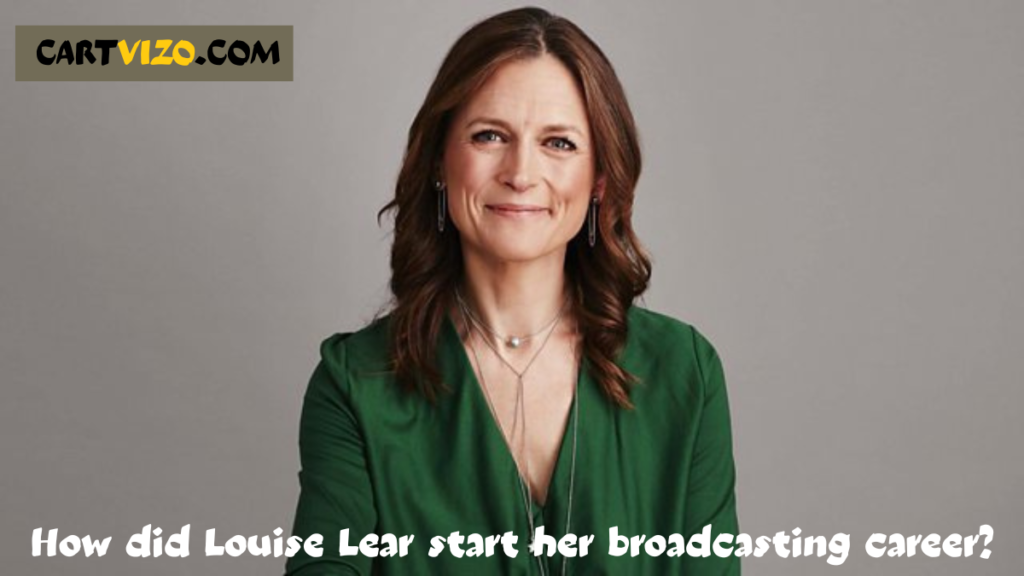
Lear’s early broadcasting experience was not immediately centred on weather.
According to biographical records, she first worked as a researcher for Children’s BBC. She then moved into sports presentation for an independent radio production company. Her sports broadcasting work included coverage connected with major events, including the 1994 Winter Olympics in Lillehammer.
This period is important because live sports and live weather have something in common: there is very little room for hesitation.
When a presenter is working live, there may be no opportunity to stop, rewrite a sentence and record it again. The presenter has to keep communicating even when circumstances change.
That kind of experience can be extremely valuable later.
Lear subsequently began working as a weather presenter at Central Television in 1992. She also spent a period at LBC in London before joining the UK Weather Channel when it launched in 1996.
Her move into weather therefore happened gradually rather than overnight.
When did Louise Lear join the BBC?
One of the major milestones in Louise Lear’s career came in April 1998, when she joined the BBC.
She went on to become a regular weather presenter across BBC services, including national news programming. She has also appeared on BBC World News, BBC Radio and other BBC platforms.
This long association with the BBC is a major part of her public profile.
For viewers, there is also a practical reason familiar weather presenters tend to stand out. Weather forecasts are short. A presenter may only have a few minutes to communicate a large amount of information about temperatures, rainfall, wind and regional conditions.
The audience needs to understand the important part quickly.
That makes presentation style surprisingly important.
Why is Louise Lear well known?
Louise Lear’s recognition comes largely from the consistency of her television work.
She has presented weather forecasts on major BBC news programmes and has also appeared on BBC Breakfast. Her broadcasting credits include both regular forecasts and other television appearances.
One moment that received particular attention came in 2016, when Lear famously struggled to contain her laughter during a BBC weather forecast. BBC News reported on the incident at the time, turning what might normally have been a small live-TV mistake into a memorable broadcasting moment.
That incident is actually useful when thinking about television presenting.
Viewers often remember imperfections more than perfectly delivered scripts. A presenter laughing unexpectedly, losing their place or reacting naturally can make live television feel more human.
It also demonstrates one of the challenges of live broadcasting: once the camera is on, unexpected things can happen.
Louise Lear and BBC Breakfast
Lear has also been associated with BBC Breakfast, where she worked as a weather presenter.
BBC Breakfast presents a slightly different challenge from a short standalone forecast. The programme runs for a long period and moves between interviews, news reports, sport, business and weather.
A weather presenter therefore has to fit into the rhythm of a much larger programme.
For example, someone watching the programme before leaving for work may want to know whether they need an umbrella. A commuter may care more about wind or frost. Someone planning a journey may be interested in visibility or snowfall.
A good forecast has to provide useful information without drowning the viewer in technical detail.
That basic principle applies beyond television too.
If you are checking the weather on a phone before leaving home, you probably do not need a complicated meteorological lecture. You need something practical: What will happen, when will it happen, and what should I do about it?
Her experience beyond weather forecasting
It would be misleading to describe Louise Lear as someone who has only ever presented weather.
Her BBC work has included other programmes, and she presented Trading Up on BBC One. Her experience renovating houses with her husband was reportedly one reason she was considered suitable for the property-related programme. She has also presented weather on Countryfile.
This wider experience gives some context to her career.
Television presenters who can work across different formats are often more adaptable because they understand how audiences and programmes differ.
A weather forecast requires speed and clarity.
A property programme requires a different style of communication.
A radio broadcast depends much more heavily on voice because viewers cannot see the presenter.
These are different skills, even though they all fall under broadcasting.
What can we learn from Louise Lear’s career?
The most useful thing about Lear’s career is perhaps not a single television programme or award. It is the way different skills appear to have built on one another.
Consider the progression:
Music and drama → television research → sports radio → weather presentation → national television.
There is a logical connection once you look at it backwards.
Music can help develop timing and listening.
Drama can help with confidence, voice and performance.
Research work teaches how television production operates.
Sports broadcasting develops live communication skills.
Weather presentation combines many of those abilities.
This is useful for anyone considering a career in media.
You do not necessarily have to start by trying to become a television presenter. Working behind the scenes, producing content, writing, reporting, podcasting or presenting on local radio can all provide useful experience.
How does a weather presenter actually make a forecast useful?
It is easy to think that the weather presenter simply reads information from a screen.
The reality of communicating a forecast is more complicated.
Imagine that tomorrow’s forecast shows rain in the morning, stronger winds during the afternoon and clearer conditions later.
A useful presenter does not simply list every number.
Instead, the information can be turned into something a viewer can act on:
- Morning: take an umbrella.
- Afternoon: allow extra time if travelling.
- Coastal areas: expect stronger winds.
- Evening: conditions should become calmer.
That difference between data and useful information is important.
Modern viewers can get raw weather data from smartphone apps such as Apple Weather, Google Weather and dedicated forecasting services. The presenter’s value is partly in helping people understand what the information means.
A practical way to use weather forecasts
If you are checking a forecast before a trip, there is a simple approach that works better than looking only at the temperature.
Step 1: Check the hourly forecast
Look at the period when you will actually be outside.
A daily forecast might say 18°C and rain, but that does not tell you whether the rain is expected at 8 a.m. or 8 p.m.
Step 2: Check wind
Wind can change how comfortable outdoor conditions feel.
A cool day with strong winds can feel very different from a calm day at the same temperature.
Step 3: Look at rainfall timing
Do not automatically assume that a rain symbol means it will rain continuously.
Check the hourly forecast and, where available, precipitation probability and expected rainfall.
Step 4: Recheck before important travel
Forecasts can change, particularly several days ahead.
For an ordinary walk, that may not matter much. For a flight, long drive, outdoor event or hiking trip, checking again closer to departure makes more sense.
Step 5: Use more than one source for unusual conditions
For severe weather, official warnings are more important than simply looking at an app’s temperature display.
The practical lesson is simple: use the forecast as information for making a decision rather than treating one number as a guarantee.
Louise Lear’s family and personal life
Lear has generally kept her personal life relatively private compared with many television personalities.
She married Ian Lear in 1990. Public biographical sources also report that the couple have children, but detailed information about their family has not been a major part of Lear’s public career.
That privacy is worth respecting.
There are many websites that publish highly specific claims about the families of television personalities, but specificity does not automatically mean accuracy. When information has not been clearly confirmed by a reliable source, it is better not to repeat it simply because it appears on several websites.
For a biography, the useful information is the information that can be supported.
What happened to Louise Lear?
This is a common question from people who remember seeing Lear on BBC television and then notice that they do not see her on every programme.
The important point is that BBC weather presenters work across different programmes, schedules and broadcasting platforms. Lear has remained listed among BBC weather presenters, and her career has continued to involve BBC weather and news broadcasting.
Television schedules also change frequently, so not seeing a presenter on a particular day does not necessarily mean they have left the organisation.
This is particularly relevant when searching online. A headline such as “Where is Louise Lear?” can make an ordinary scheduling change sound much more dramatic than it really is.
Frequently asked questions about Louise Lear
How old is Louise Lear?
Louise Lear was born on 14 December 1967. As of September 2026, she is 58 years old.
What is Louise Lear famous for?
She is best known for her long career as a BBC weather presenter, including appearances on BBC News, BBC Breakfast and other BBC services.
What did Louise Lear study?
She studied Music and Drama at Middlesex University and graduated with a BA in 1988.
When did Louise Lear join the BBC?
She joined the BBC in April 1998, after earlier broadcasting work in television, radio and weather presentation.
Was Louise Lear a weather presenter from the beginning?
No. Her earlier career included research work for Children’s BBC and sports broadcasting before she moved into weather presentation.
Has Louise Lear worked outside weather?
Yes. Her television work has included programmes such as Trading Up and Countryfile, in addition to her weather work.
Final thoughts on Louise Lear
Louise Lear’s career is interesting because it does not fit the idea that successful broadcasters follow one perfectly planned route.
Her journey moved through music and drama, television research, radio, sports broadcasting and weather before she became a familiar face on BBC television. That variety seems especially relevant when considering what makes a good presenter: communication is not just about knowing the subject. It is also about timing, confidence, adaptability and understanding what an audience actually needs to know.
Perhaps that is why her career has lasted for so long.
Weather information changes every day, but the basic job remains the same: take complicated information, make sense of it and communicate the useful part clearly. For a viewer deciding whether to carry an umbrella, change a travel plan or simply know what the afternoon will look like, that clarity matters far more than flashy presentation.
And that is probably the most interesting thing about Louise Lear’s career. Behind the familiar weather map is a broadcaster whose experience was built gradually, one role and one broadcast at a time.
Next Read: mark hines