
mathplayzone can be difficult for some students, especially when lessons involve long calculations, multiplication tables, fractions, or algebra. A page full of numbers can feel boring after a few minutes. However, learning becomes more interesting when students can solve problems through games, challenges, and interactive activities. This is where platforms such as MathPlayzone may attract the attention of students, parents, and teachers.
MathPlayzone is a name that suggests a place where users can explore math-related activities in a more enjoyable way. People searching for MathPlayzone may be looking for online math games, practice exercises, educational resources, or activities that help children improve their number skills.
Before using any website with this name, it is important to check its exact web address and available features. Websites can change over time, and similar names may refer to different services. This guide explains how to approach MathPlayzone, how math games can support learning, and how to make online practice useful for everyday study.
What Is MathPlayzone?
MathPlayzone can be understood as a math-focused learning destination where games and practice activities may help users work with numbers in an engaging way. The idea behind a math playground is simple: instead of only reading rules or copying answers into a notebook, learners get opportunities to solve problems and see how well they perform.
For example, a child who struggles with multiplication might find it easier to answer short questions in a timed game than to complete twenty similar questions on paper. Each correct answer provides a small sense of progress, while an incorrect answer gives the child another chance to understand the calculation.
However, the exact features of MathPlayzone depend on the specific website being visited. Without verifying the official site, it would not be accurate to claim that it offers particular games, accounts, progress reports, or learning tools.
A parent or teacher should check the website’s available activities, age suitability, privacy information, and any requirements before recommending it to a child.
Why Are Online Math Games Useful?
The main advantage of math games is that they can make regular practice feel less repetitive. Students still need to learn mathematical rules, but an interactive activity can give them a different way to apply those rules.
Consider a student who knows that seven multiplied by eight equals fifty-six but often forgets the answer during a test. A short multiplication game can provide repeated practice with that fact. After answering it several times, the student may begin to recall it more quickly.
There are several other possible benefits.
1. They Encourage Regular Practice
Learning mathematics requires repetition. A student cannot usually master multiplication, fractions, or division after seeing each topic only once.
Games can make short practice sessions easier to maintain. A child might spend ten minutes answering number questions after school instead of avoiding the subject completely.
The important point is consistency. Ten minutes of focused practice on most school days can be more useful than one long session followed by several days without revision.
2. They Help Students Notice Mistakes
When solving problems on paper, a student may finish an entire worksheet before discovering an error. Some interactive activities provide immediate feedback, allowing learners to check an answer while the problem is still fresh in their minds.
For example, suppose a student answers 42 when asked to multiply six by seven. If the activity identifies the answer as incorrect, the student can stop and work through the calculation again.
Not every educational website provides detailed explanations, so learners should not assume that a game will teach them everything automatically.
3. They Can Build Confidence
Students sometimes believe they are bad at math simply because they make mistakes or need more time than their classmates.
Short activities with manageable questions can help them recognize their progress. A student who correctly solves eight out of ten problems may feel encouraged to continue and work toward nine correct answers next time.
Confidence should come from understanding and improvement, rather than from collecting points alone.
4. They Offer Flexible Practice
Online activities can be useful at home, in a classroom, or during a short break between other tasks.
A student with a Chromebook at school can use a browser-based activity if the teacher permits it. At home, a family might use a Windows laptop, an Android tablet, an iPad, or a phone with a suitable screen.
The experience will depend on the website, the device, and the quality of the internet connection.
How to Get Started With MathPlayzone
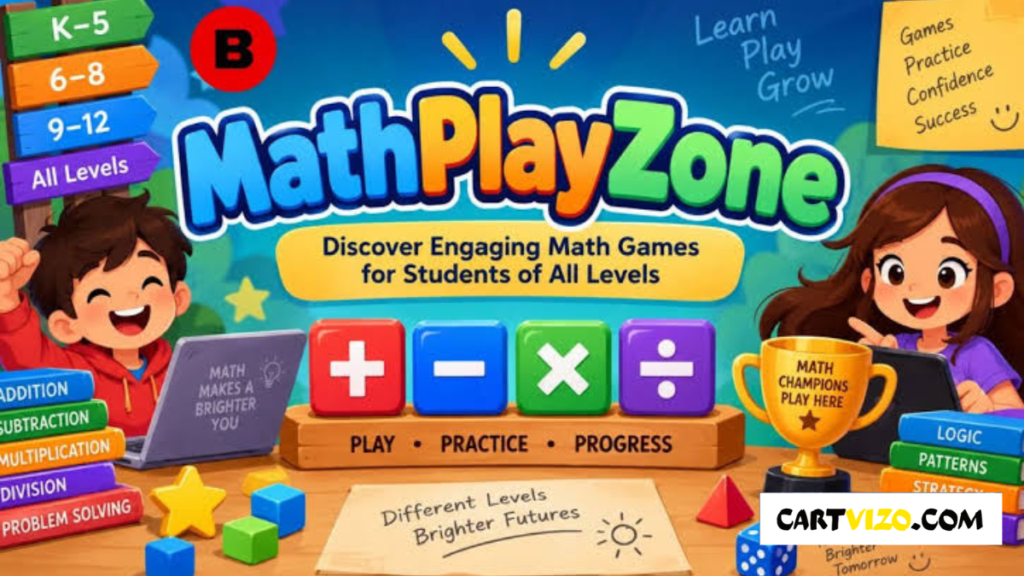
If you want to explore MathPlayzone, start by checking that you have found the correct website. Do not assume that every page using a similar name is connected to the same service.
The following steps provide a practical way to begin.
Step 1: Find and Check the Website
Open a trusted search engine and search for the exact term “MathPlayzone.”
Look carefully at the results before opening a page. Check the domain name, the site’s description, and whether the page appears to be an educational resource rather than an unrelated service.
Be cautious with websites that use misleading download buttons, unexpected pop-ups, or claims that you must install an unknown program before playing a simple math game.
If you are helping a child, review the website yourself before allowing the child to explore it.
Step 2: Check the Available Activities
Once the page opens, look for categories or descriptions that explain what the site offers.
Useful math activities commonly include:
- Addition and subtraction practice
- Multiplication tables
- Division problems
- Number recognition
- Fractions and decimals
- Basic geometry
- Logical reasoning and number puzzles
These are examples of common educational activities, not a confirmed list of MathPlayzone features. Use only the categories that are actually available on the website you visit.
Choose an activity that matches the learner’s current level. A child who is still learning multiplication will probably benefit more from simple multiplication questions than from advanced algebra problems.
Step 3: Start With an Easy Activity
It is tempting to choose the hardest game immediately, especially when a score or timer is displayed on the screen. However, difficult questions can become frustrating when the basic rules are not yet clear.
Begin with an activity that the learner can mostly complete without assistance.
For instance, if a student is practising addition, start with small numbers such as 12 + 5 or 23 + 14. Once those calculations become comfortable, move to larger numbers or questions involving carrying.
The aim is to build a strong foundation before increasing the difficulty.
Step 4: Play for a Short, Set Period
Choose a reasonable practice period, such as ten to fifteen minutes.
During this time, focus on solving the questions rather than rushing through them. If a game has a timer, try one round without worrying about the score. Use the next round to improve speed after accuracy becomes more reliable.
Short sessions are particularly useful for younger children, who may find it difficult to concentrate on the same task for a long time.
Step 5: Review Incorrect Answers
Do not treat a wrong answer as a reason to close the activity. Instead, identify the calculation that caused the problem.
Suppose the question is 36 ÷ 4. If the student answers 8, ask them to check the result by multiplying 8 by 4. Because the result is 32 rather than 36, the student can see why the answer needs another look.
Writing a difficult question in a notebook can also help. The student can solve it slowly on paper and then return to the activity for more practice.
Step 6: Repeat the Activity Later
One successful session does not guarantee that a skill has been mastered.
Return to the same topic the next day or later in the week. If the learner can answer the questions correctly without guessing, try a slightly more challenging activity.
This simple routine helps turn an entertaining activity into a useful learning habit.
Practical Ways to Use MathPlayzone for Schoolwork
Online math games are most helpful when they support a clear learning goal. Instead of opening a game without a plan, choose an activity based on what the student needs to practise.
Practising Multiplication Tables
Multiplication tables are an important foundation for division, fractions, percentages, and algebra.
A student who struggles with the seven times table can practise it in short sessions. After playing, ask the student to write the answers to seven multiplication questions in a notebook.
For example:
- 7 × 3 = 21
- 7 × 5 = 35
- 7 × 8 = 56
- 7 × 9 = 63
If the student gets an answer wrong, repeat that question rather than restarting the entire learning process.
A useful goal is to improve accuracy first and speed second.
Improving Addition and Subtraction
Younger students often need help understanding how numbers fit together.
A simple addition activity can reinforce calculations such as 18 + 7. The learner can first break seven into two and five, making 18 + 2 = 20 and 20 + 5 = 25.
After practising through a game, the student can explain the method aloud or draw it on paper. This extra step helps show whether the learner understands the calculation instead of simply remembering a previous answer.
Learning Fractions
Fractions can be confusing because children must understand both numbers and the relationship between them.
A visual activity showing parts of a whole may help students understand why one-half is larger than one-quarter.
For example, imagine two equal-sized pizzas. One pizza is divided into two equal pieces, while the other is divided into four equal pieces. A single half is larger than a single quarter because it represents a larger share of the same-sized whole.
If MathPlayzone does not offer suitable fraction activities, a teacher or parent can use a paper drawing or another trusted educational resource to explain the concept.
Building Logical Thinking
Not every useful math activity needs to involve a standard calculation.
Number sequences, patterns, and simple puzzles can help learners identify relationships between numbers.
Consider the sequence 3, 6, 9, 12, __. The missing number is 15 because each number increases by three.
Ask the learner to explain the pattern. Explaining why an answer is correct can develop deeper understanding than choosing the right option alone.
Is MathPlayzone Suitable for Children?
Suitability depends on the actual website, the content available, and the age of the child.
A site with clear instructions, simple activities, and limited distractions may be appropriate for supervised educational use. A page containing aggressive advertising, inappropriate material, or unclear download prompts may not be suitable.
Parents should check several things before allowing children to use an unfamiliar platform.
Check age suitability. Make sure the questions and instructions match the child’s reading and math level.
Review privacy practices. Look for a privacy policy and determine whether the site asks for names, email addresses, dates of birth, or other personal information. Avoid sharing unnecessary details.
Check account requirements. If an account is required, understand what information it collects and whether a free alternative is available.
Watch for external links. Some websites display advertisements or links to other services. Explain to children that they should not click unfamiliar offers or enter personal details without permission.
Set reasonable screen-time limits. Math games should support learning rather than replace sleep, physical activity, reading, homework, or time with family.
For younger children, an adult can sit nearby during the first few sessions and help them understand the instructions.
Can You Use MathPlayzone on a Mobile Phone?
Many educational websites work through modern mobile browsers, but compatibility depends on the particular site.
If you want to try a math activity on an Android phone or iPhone, open the website in a current browser such as Google Chrome or Safari.
Check whether the page fits the screen, the buttons are easy to tap, and the questions remain readable without excessive zooming.
If a game feels awkward on a phone, a tablet or laptop may provide a better experience. Some activities require a larger screen, especially when they display diagrams, geometry problems, or several numbers at once.
You should also avoid installing an app simply because a website displays a download prompt. First check whether an official app actually exists and whether it is distributed through a trusted app store.
A website that works in a browser may not need a separate application at all.
Common Problems and How to Handle Them
Even a useful learning website can become frustrating when technical problems or unsuitable activities interrupt practice.
The Website Does Not Load
Start by checking your internet connection. Open another trusted website to see whether the problem affects your entire connection or just one page.
If other sites work normally, reload the page and try again after a short wait. You can also test a different browser or restart the browser if it has become unresponsive.
Avoid downloading software from unofficial pages that claim to repair the website.
The Game Is Too Difficult
Choose a simpler activity or return to the underlying topic in a textbook.
If a learner repeatedly struggles with division, for example, review multiplication tables first. Understanding that 6 × 4 = 24 makes it easier to understand why 24 ÷ 6 = 4.
Moving to an easier activity is not a failure. It is a way to identify and strengthen a missing skill.
The Student Focuses Only on the Score
Points and timers can make games exciting, but they can also encourage careless answers.
Ask the learner to explain a few answers after each round. If accuracy drops whenever the timer appears, practise without time pressure until the calculations become more familiar.
The most useful result is improved understanding, not simply a higher score.
Too Many Advertisements Appear
Some free websites support their services through advertising. However, advertisements should not make an educational page difficult or unsafe to use.
If pop-ups interfere with the activity, close the page and review the website’s suitability. Never enter payment details or install an unfamiliar extension just to remove a warning or unlock a supposedly necessary feature.
Parents should pay particular attention to advertisements shown around children’s content.
MathPlayzone Compared With Other Learning Methods
Math games are one option among several. The best learning routine often combines interactive practice with written work and direct explanation.
| Learning method | Main advantage | Possible limitation |
|---|---|---|
| Online math games | Interactive and engaging practice | May focus too heavily on speed or points |
| School textbooks | Clear explanations and structured lessons | Can feel repetitive without varied exercises |
| Paper worksheets | Easy to review mistakes and show working | Usually provide no immediate feedback |
| Video lessons | Helpful for seeing a method demonstrated | Students may watch without practising |
| Teacher or parent guidance | Allows questions and personalised explanations | Requires another person’s time |
For example, a student learning percentages might first read the relevant textbook section, watch a short explanation if needed, practise a few calculations on paper, and then use a suitable online activity for additional questions.
This combination helps connect the game to the mathematics being taught in school.
How Parents and Teachers Can Track Progress
A complicated tracking system is not necessary for basic math practice. A notebook can provide enough information to identify improvement.
After each session, record the date, topic, number of questions attempted, number answered correctly, and any problem that caused difficulty.
Imagine a student answers 12 out of 20 multiplication questions correctly during the first session. A few days later, the student answers 16 out of 20 correctly.
That change suggests progress, although it does not prove that every multiplication fact has been mastered. The learner should still practise different questions and demonstrate the skill without relying on repeated examples.
A simple weekly routine might look like this:
- Monday: Practise multiplication.
- Tuesday: Review incorrect multiplication questions.
- Wednesday: Work on division.
- Thursday: Practise fractions or number patterns.
- Friday: Revisit the week’s most difficult questions.
Adjust the plan to the student’s age, schoolwork, and attention span. There is no need to use every topic every week.
Tips for Getting More Value From MathPlayzone
A few small habits can make online math practice more effective.
First, decide what you want to learn before opening the website. A clear goal, such as practising the six times table, makes it easier to choose a suitable activity.
Second, keep paper and a pencil nearby. Written calculations help learners understand the steps behind an answer, particularly when working with larger numbers or fractions.
Third, avoid guessing repeatedly. If a question is confusing, pause and work it out rather than clicking random answers.
Fourth, take breaks when concentration begins to drop. A tired learner may continue playing without paying attention to the calculations.
Finally, compare performance over several sessions instead of judging progress by one result. Some days will be easier than others, and difficult topics often require more repetition.
Frequently Asked Questions About MathPlayzone
What is MathPlayzone used for?
MathPlayzone is a name associated with interest in math-based online activities. Depending on the specific website, users may be looking for games, practice questions, or educational resources. Check the actual site to confirm its available features.
Is MathPlayzone free?
Its pricing cannot be confirmed without identifying the exact website. Check whether the service offers free activities, paid subscriptions, or optional purchases before using it.
Do I need to create an account?
That depends on the website. If registration is requested, review the privacy policy and consider whether an account is necessary for the activity you want to use.
Can adults use math games too?
Yes. Adults can use suitable math activities to practise mental arithmetic, refresh basic skills, or help children with schoolwork. The best choice depends on the learner’s current level and goals.
Do math games replace school lessons?
No. Math games can provide additional practice, but students still need clear explanations, written problem-solving, and opportunities to ask questions. A game is most valuable when it supports those other learning methods.
What should I do if MathPlayzone is unavailable?
Check the web address, try again later, and test another browser if necessary. You can also practise the same topic with a textbook, worksheet, or another trusted educational resource while waiting.
A Better Way to Make Math Practice Enjoyable
MathPlayzone may be worth exploring if you are looking for an interactive approach to mathematics, but the exact website should always be checked before relying on its features or recommending it to children.
The most important part of successful math practice is not the name of the platform or the number of points a game awards. It is whether the learner becomes more comfortable working with numbers, understands mistakes, and can apply a skill without help.
Start with one topic, practise for a short period, and review the questions that cause difficulty. Combine online activities with paper exercises and explanations whenever necessary.
With a little planning, a math game can become more than a way to pass the time. It can be a practical part of a learning routine that helps students approach difficult questions with greater patience and confidence.